
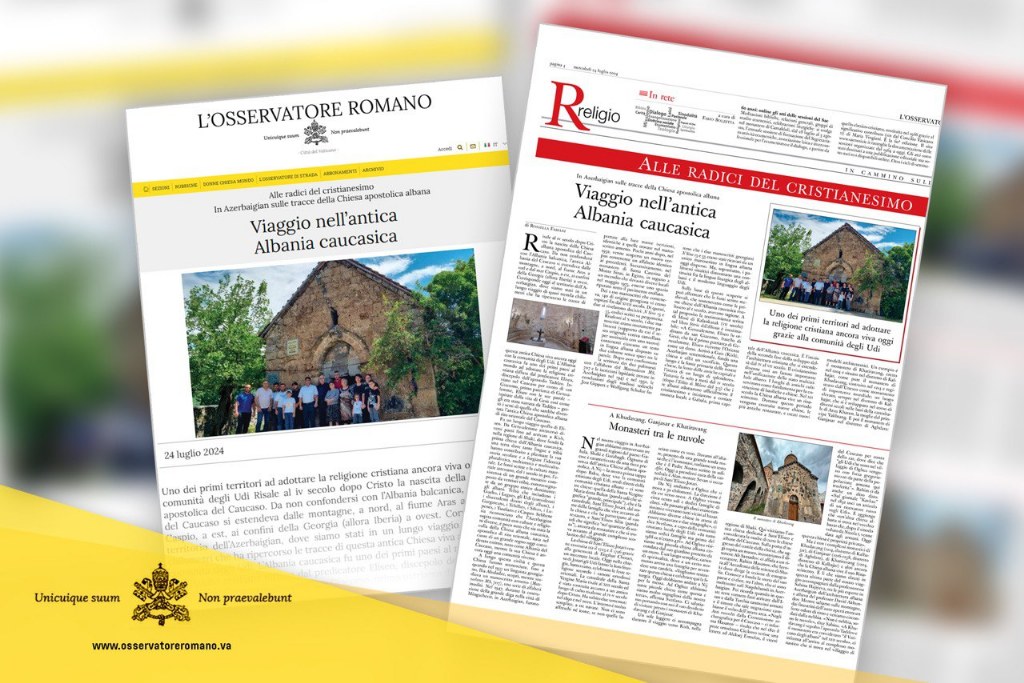
History of the monuments of Caucasian Albania highlighted in the Holy See’s sole official publication
An article titled “At the Roots of Christianity. In the Footsteps of the Albanian Apostolic Church in Azerbaijan. A Journey to Ancient Caucasian Albania” has been published in the newspaper “L'Osservatore Romano”, the official newspaper of the Holy See.
The article pays considerable attention to the history of the establishment of the Albanian Apostolic Church in the Caucasus, highlighting important historical facts and realities. It notes that the first church of Caucasian Albania was built in the village of Kish in the Shaki district, with its first capital located in the city of Gabala. Furthermore, it emphasizes that during the 12th century, the Albanian Church underwent a renaissance, marked by the construction of new churches, restoration of the oldest ones, and the creation of new architectural examples.
The article provides information about notable monasteries, such as Khudavang (Dadivank) in the Kalbajar district, which is registered by UNESCO as a monument of world significance, as well as Gandzasar and other monasteries. It also addresses the attempts at the so-called “Gregorianization” of the heritage of Caucasian Albania, which allegedly began following the signing of the Treaty of Turkmenchay, which facilitated the resettlement of Armenians from other states into the territories of the Karabakh, Iravan, and Nakhchivan khanates.
Notably, the author of the article, Rossella Fabiani, visited Azerbaijan from June 22 to July 2 at the invitation of the Embassy of Azerbaijan to the Vatican, the Heydar Aliyev Foundation, and the State Committee. During her visit, the journalist toured the districts of Guba, Gabala, Oghuz, Shaki, Aghdara, Khojavand, Kalbajar, and Lachin, and the city of Shusha, exploring churches, a synagogue, and monuments of Azerbaijan’s ancient Christian Albanian heritage. She also met with the Alban-Udi Christian religious community in the settlement of Nij in the Gabala district and visited the “Holy Mother Mary” and “St. Eliseus (Cotari)” churches, where she received detailed information about the Albanian Christian heritage.
The full article can be assessed at the following link:
https://www.osservatoreromano.va/it/news/2024-07/quo-167/alle-radici-del-cristianesimo.html